Friday, January 17, 2014

The northwest burbs

Today we started at the western wall.  We didn't go into the plaza where the wailing wall is, but instead walked the tunnel that the Israelis have built that exposes all of the wall (there is a lot of controversy about it since the Muslims are convinced the Jews are trying to dig under the Temple mount and collapse the Dome of the Rock).

After that, we got on our bus and headed to the northwestern suburbs of Jerusalem to visit the churches of the Visitation and John the Baptist.  I assumed that they would be the same church, but as we see in Luke 1:24, Elizabeth withdrew into seclusion to ponder John's conception (seclusion in this case means up into the hills into a then rural area).  Both are our standard spilt-level Byzantine lower-renovated Crusader into modern upper structure (seriously it's going to be weird to go back home and not have another older church in the basement), but the Church of the visitation had really cool wall paintings and a piazza. John the Baptist also had a cool courtyard, but the upper church was covered in tile, so it was a bit strange (though it had the better lower church).
The piazza at the Church of the Visitation 
Under the oldest altar at St. John's. The Latin translates to here
 the forerunner of the Lord is born.  There is a similar place at Nazerth that
says the word became flesh here
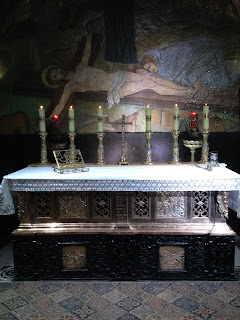
In the afternoon we visited one of the three possible Emmaus sites (there are ruins of towns the correct distance away in three directions).  This one is run by the Benedictines, and they haven't renovated their Crusader church, so although the paintings are falling apart and were defaced by Muslims, it gives you an idea of what the Crusader churches would have looked like.
The main altar
Tomorrow is our second free day, but since it is my turn to preach at evening prayer (this is a preaching practicum course after all), I will probably spurn most fun things and endlessly worry over my homily.

Thursday, January 16, 2014

Eastern Jerusalem

We started today by going to the Mount of Olives, and spent most of the morning in the Garden of Gethsemane, which was a working olive grove, and these days has a lot of churches in it. We started with mass at the chapel of Dominus Flevit (Latin for the Lord weeping), which was very nice (though mass went longer than most of us were expecting, we got used to half-hour masses). The altar piece really motivated me to pray for those who had done Cursillo, as it was a mother hen gathering her chicks, and for my teaching parish which had a large Cursillo group.
Des colores!
As a side note, the majority of the mount is a giant cemetery, as Rabbinic tradition hold the messiah will enter the temple from the golden gate on its east side and the resurrection will begin there. Walking past the cemeteries, we visited the very impressive Russian Orthodox church of Mary Magdalene, which sadly bans cameras in the church.
St Mary Magdalene
Then we went to the Church of All Nations. Like St. Peter in Gallicantu, the name hides a very impressive site, in this case, the rock that tradition (based upon long standing devotion, even pre-Byzantine) holds as the place where Jesus prayed in the garden after the last supper.  It's built over a Byzantine church's plan, and the current church went to the trouble of matching the crusader church's floor mosaics (so I am very impressed).  The name comes because in 1927 when they renovated the current church they asked for support from the Knights of the Holy Sepulcher and got overwhelming support from many nations.  Each of the major donor nations has a mosaic donated to it, most of which are in the domes (of which there are 12: if you're following Theology II's blog, it's similar but a lot smaller than Westminster Cathedral).
The church
After a holy hour there and lunch, we went to the City of David, the oldest part of Jerusalem, and saw the ruins there.  It is a highly controversial site because it is a Palestinian neighborhood that the Israelis are buying up and tearing down so they can do archaelogical digs.  The highlight of the trip was exploring the old water system, and the majority of the group stayed dry and went through the old  Canaanite tunnel, but a few of us (including me, mom, so I didn't "wuss out" like I did at the Dead Sea) went through Hezekiah's tunnel, which he built in anticipation of Assyrian invasion.  It has water in it which is waist-deep for about 5 feet, so I didn't bring my phone.  Both tunnels feed into the pool of Siloam (see John 9).
Looking at the old walls near David's palace
Despite being told that we didn't have any early starts left except for the airport, tomorrow we are getting up very early to walk the length of the western wall (or wailing wall). But to make up for it, we are having mass at the birthplace of John the Baptist, which then and now is in a suburb of Jerusalem.

Wednesday, January 15, 2014

All around Jerusalem

Today we started very very early with mass at Golgotha. We didn't get to use the main altar because it is Greek Orthodox and sadly, despite it being the week of Christian unity, we aren't to that level of union yet. Instead we celebrated mass at the altar of the eleventh station of the cross, which is all of ten feet from the main altar.  This altar was paid for by the Medici and was built in 1588, so we weren't exactly settling.
The 500 year old altar we "settled" for.  The mosaic is better in person
After a brief tour of the side chapels, including the rather depressing Syrian Orthodox chapel (it badly needs renovation, but it's techincially on loan from the Armenians, and they and the Syrians want to do it themselves, so the project has been in limbo for decades) and the cool chapel of St. Helena, and breakfast, we went to the western citadel near the Jaffa gate.  Despite tradition and possible ruins depending on interpretation, this is not the citadel of David.  It has amazing views of the old city, so most of us took selfies for Facebook and the like.
The gate in
The inner courtyard
Then we went to the Church of St. Peter in Gallicantu (that last word is Latin for rooster's crow), and to be honest I was expecting it to be dull, but it is probably my favorite site so far. It is on Mount Zion and has a stunning view of the Mount of Olives and the old city, as well as the valleys.  As is typical, there are two churches, an upper and lower one, and the upper has these amazing art nouveau mosaics and a stained glass cross in the dome. The lower church has an amazing icon series of Peter denying Christ, Peter repentant, and Peter restored, and as expected is built over a Byzantine basilica.  But under this basilica when they did excavations, they found the ruins of a second temple period villa, and in this villa they found an old cistern that had been clearly turned into a prison marked with Byzantine crosses.
One of the crosses
According to all the Gospels, Peter's denial takes place at the house of the high priest, where Jesus was imprisoned overnight after being found guilty of blasphemy by the Sanhedrin (which in this case meet at the high priest's house) before being tried and crucified by Pilate.  St. Peter in Gallicantu is built over the place where Christ was imprisoned, and so we got to go and stand in place where Jesus spent his last night before the crucifixion.  It was a very moving experience, on par with seeing the Cenacle or Golgotha because they are all connected in the passion of Christ.  And unlike the other two, this site is largely ignored, so there is great stillness for prayer.
The prison cell
We rounded up the day by heading to the Israeli museum, which has the dead sea scrolls, a large archaeological collection, and a very decent art collection.  Unfortunately, the site, which is quite large, is very poorly curated and organized, so while I enjoyed the scrolls, the Picassos, and a traveling exhibit on the Plains Indians, I missed out on the Chagalls, and the chief scroll on display is a facsimile.  if I hadn't discerned properly and instead had followed my plan to be a curator, I would have even stronger opinions (but I would never have seen the Israeli museum).

Tomorrow we are running around the oldest part of Jerusalem, built by David after he conquered Salem.

Tuesday, January 14, 2014

Return to Jerusalem


Today we left Eilat and on our way back made some fun side trips.  The first stop was at a nature park in the En Gedi wilderness.  1 Samuel 24 took place somewhere around there, and there was a series of pretty though small waterfalls that feed eventually into the Dead Sea.

After that, we went to the Dead Sea,and most of us went floating. Sadly, I got the open blister that I was afraid of a couple days ago while in Petra, so I avoided the water.  We spent too long there, so we had to truncate our tour of Jericho.  Jericho is impressive, though we spent most of the time viewing the oldest part of the city.
The Dead Sea
After, we got to go back to Jerusalem.  We're staying in the same place and even in the same room, and it was very comforting to come back to our home base for the rest of the trip.  We came in by the Jaffa Gate, which meant that from my free day I knew exactly where we were going, which also helps with my feeling of stability.
A 10,000 year old tower (yes, 10,000)
Us at old Jericho
Tomorrow is going to be a very full day starting with a mass at 6:30 at Golgotha, so that should be as impressive as the tomb at the Cenacle.

Monday, January 13, 2014

Petra


Yesterday (or today for most readers) was spent mostly getting to and from Petra, which is two and a half hours plus a border crossing away from Eilat. I still have no idea as to how Petra connects to the Bible other than it being very likely that the Hebrews wandered through the general area on their way to the promised land 700 or 800 hundred years before the city was founded and almost 1200 years before the famous parts of city were built.
One of the narrow parts of the canyon. During the Exodus, it would have been a riverbed.
Petra is an architectural masterpiece, but to be honest, I was a bit disappointed. Most of the cool buildings are temple-tombs, and they don't allow you inside the famous Treasury (despite the name, it is one of the temple-tombs). Petra has an impressive theater carved into a hillside, but since we've seen freestanding Roman theaters of similar size and design, we were not as impressed as our guide thought we would be.  The structures are also sprawled out over a couple of miles of canyon walls with little rhythm or reason except the allowance of space.  Compare this to the tels and Roman cities which had to maximize space, and it just seems piece-meal in design because it was.
The treasury. Sadly not the resting place of the Holy Grail
The royal tombs from the first century AD, about a mile from the treasury
Despite this griping, we still had fun.  A lot of the class got kippahs (or shemaghs) in Jordan, and I must confess we had some less than charitable jokes about our Jordanian guide, who must either get a cut from all the busking Bedouins or was really devoted to improving the Jordanian economy, because we always seemed to stop near one to extol whatever product was available (camel rides, group photos, fresh juice, the list goes on).  Either way, it made us appreciate our Israeli (really Palestinian Christian) guide more.

Tomorrow we are off to more sites that don't really relate to the Bible but provide historical/regional texture, and then we get to go up to Jerusalem (fun fact: Jews always speak of going up to Jerusalem regardless of the actual direction).

Sunday, January 12, 2014

The Judaean Desert


Sorry about taking so long to post, but it took forever to find wifi here in Eilat. Eilat is on the Red Sea and is one of Israel's resort towns (and despite what some of my classmates thought, Jewish not Palestinian).  We're using it as our home base for our trips into the Negev (which contains both the Judaean and Jordanian deserts).

On our way down we stopped at Qumran and Jericho. Qumran is where the dead sea scrolls were written and eventually hidden by a isolationist sect of Jews called the Essenes who were active from about 150 BC to the first Jewish revolt (68 AD). Based upon their beliefs, they seem like a cross between Trappists and Amish who had the misfortune of being in the way when the Romans were moving south to deal with our second site, Masada.  They hide their scrolls in caves, and we will see them when we are back in Jerusalem, so the rest of the story can wait.
Two of the caves where scrolls were found
One of the ritual baths with some of the settlement behind
Masada was built as Herod the Great's bolt-hole. If something went wrong, and the Jews revolted in large numbers, Herod wanted some place safe to stay while waiting for Rome to come save him, and being Herod, wanted to hide in style.  He built a very impressive palace-fortress complex on top of a mountain, and kept it well-stocked enough to hold out for years.
The lift/gondola/whatever up
After Herod, the Romans kept it stocked, but didn't keep a large enough garrison to hold it, so the Zealots took it in the first days of the revolt.  It was the site of last stand of the revolt.  It has a lot of meaning to Israelis as a symbol of resistance even when defeat is inevitable, but what struck me was the sheer scale of the Roman siege works around the site, which are very well preserved because of the desert climate.
The Roman fortifications around the mountain
More Romans, but of a different type
Tomorrow we are off to see Petra if the border crossing goes well, and then back to Jerusalem via the Dead Sea.


Saturday, January 11, 2014

First free day


Today we got up very early for mass at the cenacle at 6.  It was amazing, as we stood in the antechamber and Fr. Klockeman said mass on the slab of the tomb itself (they have a portable altar that goes over it).   
Thank goodness Br. Alvaro lacks my qualms about taking photos during  mass
Almost nothing in Jerusalem opens until 9, so most of us napped following breakfast.  I spent the rest of the day wandering the old city (don't be worried by the singular, parents, I was in a group), and saw but didn't pray at the Wailing Wall because it was very full (Shabbat and all, plus we are going on the 17th).  I visited the co-cathedral of the Latin Patriarchy, and saw the ruins of the old citadel by Jaffa gate.  Jaffa is one of the main gates, so it was fun to people watch.
The Jaffa Gate
I also walked outside the gate to the new city which has a nice mall. It was a little slice of home though unlike home it was closed because of Shabbat.  To close off the day, the Des Moines seminarians ran into their bishop earlier in the day, and invited some of us to join him for drinks. Bishop Pates confirmed me and supervised my parents for a number of years, so it was very good to see him.
The city from outside the walls
Tomorrow we are off to the Red Sea and Eilat, to do Dead Sea sites and Petra.  I really hope I can find an Indiana Jones hat to be tempted by.